What "embedded" means
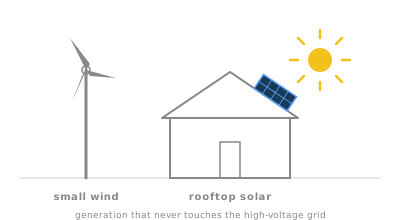
Embedded generation is electricity generated below the transmission system, wired into the lower-voltage distribution network instead of the 400 kV high-voltage backbone. The technical term is behind-the-meter at the household scale, or distribution-connected at the small-farm scale.
What it actually looks like:
- Rooftop solar on houses and warehouses (almost all British solar is embedded)
- Small wind farms under ~50 MW connected to local distribution
- Industrial solar farms sited near a distribution substation rather than at a transmission node
- Community solar on schools, churches, car parks
When the sun shines, that generation flows first into the building's own demand. Anything left over spills out into the local distribution feeder, where it's consumed by neighbours. Only the surplus left at the area level pushes back up into transmission, where grid operators can see it.
Why Elexon doesn't see it
Elexon, the body that operates Britain's wholesale electricity market, only measures what flows across the transmission system. Its FUELINST feed reports every Balancing Mechanism (BM) generator: the gas plants, the nuclear stations, the big offshore wind farms, the interconnectors. Rooftop solar isn't in the BM. It's not metered nationally; it doesn't get a contract; it doesn't get a settlement.
So Elexon's "Solar" reading is just the handful of utility-scale ground-mounted farms that are in the BM. On a sunny midday with 14 GW of solar generating across Britain, Elexon's number might be 200 MW.
How NESO fills the gap
The system operator, NESO, runs a separate embedded forecast that estimates rooftop generation from weather data, installed capacity registers, and metered samples. It publishes the result in the half-hourly demand CSV under two columns:
EMBEDDED_SOLAR_GENERATIONEMBEDDED_WIND_GENERATION
The values are estimates, not measurements. But they're calibrated against the day's actual transmission demand, because every kWh of embedded gen reduces what flows down from the grid. On most days, NESO's number agrees with reality to within a few percent.
How this dashboard handles it
The Generation card folds NESO's embedded numbers into the corresponding fuel buckets before drawing the donut. So when you see "Solar: 4,800 MW" at noon on a sunny day, that's roughly 50 to 500 MW of grid-connected solar from Elexon plus 4,300 to 4,800 MW of rooftop solar from NESO, together giving the true picture of British solar output.
Without this merge, the dashboard would show solar near zero at midday in June. It's the single biggest correction the data layer makes.
Why it matters
Embedded solar has grown from negligible in 2010 to roughly 18–20 GW of installed capacity by the end of 2025 (DESNZ Energy Trends), with Sheffield Solar's PV_Live recording an all-time generation peak of just over 13 GW on a clear April afternoon. At those peaks, solar briefly supplies more than 30% of British electricity by itself and pushes carbon intensity into the very low band for hours at a time.
It also makes the system harder to manage. Transmission-level demand drops sharply at midday, sometimes to under 20 GW where it used to be 30+, and rises sharply at sunset. NESO has to forecast, and respond to, a curve that's far steeper than it was a decade ago. The grid is cleaner and more interesting to run.
Common misconceptions
- "Solar barely matters because it's just rooftops." Cumulatively it's the third-largest source of British electricity in summer, behind only wind and gas.
- "Embedded is unmeasured guesswork." NESO's estimate is calibrated against settled demand, has been refined for over a decade, and is published alongside the same accountability framework as the rest of the demand data.
- "It doesn't count because it's not on the grid." It counts. Every kWh of embedded generation is a kWh that didn't come from a gas turbine. The atmosphere doesn't care which voltage level the electron was generated at.
Further reading
- NESO data portal — embedded forecasts, demand history, and methodology.
- Solar Energy UK: capacity tracker — the trade body's running count of installations.
- DESNZ Energy Trends, Section 6 (Renewables) — the official quarterly count of UK renewable capacity and generation.