What they are
An interconnector is a high-voltage subsea cable linking two grids that run on their own clocks. Britain isn't electrically connected to continental Europe by transmission lines (the way Germany is to France); instead, ten point-to-point cables stitch us into six neighbouring markets.
They carry direct current (HVDC), because that's cheaper and more efficient over long distances and lets the two grids run at their own frequencies and phase. A converter station at each end turns AC into DC for the cable and back again on the other side.
The links, today
| Cable | Country | Capacity | Operator |
|---|---|---|---|
| IFA | 🇫🇷 France | 2 GW | National Grid / RTE |
| IFA2 | 🇫🇷 France | 1 GW | National Grid / RTE |
| ElecLink | 🇫🇷 France | 1 GW | Getlink (in the Channel Tunnel) |
| BritNed | 🇳🇱 Netherlands | 1 GW | National Grid / TenneT |
| Nemo Link | 🇧🇪 Belgium | 1 GW | National Grid / Elia |
| North Sea Link | 🇳🇴 Norway | 1.4 GW | National Grid / Statnett |
| Viking Link | 🇩🇰 Denmark | 1.4 GW | National Grid / Energinet |
| Moyle | 🇬🇧 Northern Ireland | 0.5 GW | Mutual Energy |
| East-West | 🇮🇪 Ireland | 0.5 GW | EirGrid |
| Greenlink | 🇮🇪 Ireland | 0.5 GW | Equitix / Partners Group |
Total capacity: about 10.3 GW, roughly a quarter of typical winter peak demand. More are in the pipeline (LionLink to the Netherlands, NeuConnect to Germany) for later in the decade.
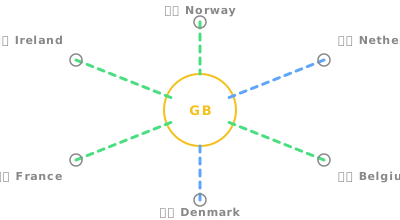
How to read the diagram
On the dashboard the interconnector card shows direction and magnitude per country. A green cable means power flowing into GB (import); a blue cable means power flowing out (export). The thickness scales to flow size. The card also gives a net number — positive means GB is currently a net importer.
Real-time direction is set by price. If Norwegian hydro is cheaper than the marginal GB gas turbine, electrons flow our way. If it's calmer here and gusty in Denmark, we export. The actual scheduling happens hours ahead in the day-ahead and intraday auctions; the cables themselves just deliver what was traded.
Why they matter
Three reasons:
- Balancing. When wind drops or a power station trips, imports plug the gap faster than firing a cold gas turbine. The reverse is true too: Britain can sink surplus wind into Europe instead of paying generators to switch off.
- Price arbitrage. Continental power tends to be cheaper at British peak times and vice-versa. Interconnectors let both sides smooth their bills.
- Decarbonisation. Norway's grid is roughly 88% hydroelectric (the rest is mostly wind, with a sliver of gas). Importing from Norway during a still British evening replaces gas-fired generation directly. On average about half of the energy crossing UK interconnectors is from low-carbon sources.
On a windy spring weekend GB has occasionally been a net exporter for 12+ hours straight, sending 3 to 4 GW into Europe. On a calm winter peak we can be importing nearly the full 9 GW capacity. The story changes hour by hour.
Common misconceptions
- "We rely on Europe for electricity." GB is a small net importer year-round, about 6 to 9% of supply over a typical year. The cables let us trade in both directions; we just import slightly more energy than we export, mostly because nuclear France and hydro Norway have a lot of surplus to sell.
- "Brexit cut us off." It didn't. Cross-border trading happens through bilateral arrangements between Britain and the EU. The cables work the same as before, though the auctioning is now slightly less efficient (explicit instead of implicit). IFA1 was partially down for nine months in 2021–22 after a fire at the converter station; Viking lost a converter for several months in 2024; built-in redundancy across the ten links means single failures rarely matter much.
Further reading
- Wikipedia: List of interconnectors to the British grid — neutral overview of every cable plus those in construction.
- Drax Electric Insights — live and historical breakdown of import / export flows by country, run by Imperial College on behalf of Drax.
- Ofgem on cross-border electricity — the regulator's policy hub; from here you can find the live cap-and-floor regime documents.