What it is
The Market Index Price (MIP) is a half-hourly £/MWh number representing the wholesale price of electricity in Great Britain for a given settlement period. It comes out of the day's spot market: the place where generators sell their output and suppliers buy enough to cover the demand they're contracted for.
A single number for a single half-hour. The Price card on this dashboard shows the latest published MIP. Multiply it by total demand and that's the rough size of the British electricity bill for that thirty-minute block.
How it's set, and why it swings
The MIP is published by Elexon under the name APXMIDP (the "data provider" being APX, now part of EPEX SPOT, who run the auction). The mechanism in three steps:
- Day-ahead auction. At noon the day before, generators submit offers (the price they'd accept per MWh) and suppliers submit bids (the price they'd pay) for each of tomorrow's 48 periods. The auction clears at a single market-clearing price per period.
- Intraday adjustments. As real-time approaches, parties trade bilaterally to adjust positions: a wind forecast came in higher than expected, a power station tripped, demand looks lower. These trades happen continuously until the period closes.
- MIP publication. Elexon publishes APXMIDP roughly 10 to 25 minutes into the period: a volume-weighted average of trades on the EPEX SPOT intraday market for that half-hour.
For most half-hours the MIP is the price at which the marginal generator (usually a combined-cycle gas turbine) agreed to supply the last MWh of demand. Cheaper generators (wind, nuclear) get paid that same clearing price even though their offers were lower. This is what makes British wholesale electricity "marginal cost" rather than "average cost".
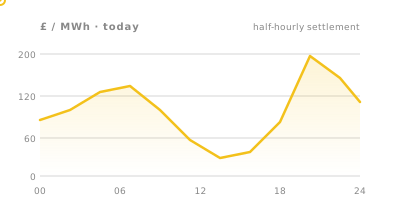
Why this produces wild swings: wholesale electricity is one of the most volatile commodities traded anywhere. A typical British day swings from £30/MWh overnight to £200/MWh at evening peak. Storm days have hit -£100/MWh (generators paid to switch off); cold-snap days have hit £2,000+/MWh.
The drivers, roughly in order of impact:
- Gas prices, because gas sets the marginal price for most periods. Gas accounts for about a quarter of British electricity by volume in 2026, but sets the clearing price in roughly two thirds of half-hours — that asymmetry is the whole story.
- Wind output, because wind has zero fuel cost and displaces gas when it's high.
- Demand, especially the evening peak after work between 17:00 and 19:00.
- Interconnector availability, because cheap imports from France or Norway suppress prices when they arrive.
- Carbon prices, because gas plants have to buy emissions allowances.
How to read it on the dashboard
The Price card shows:
- The number: pounds per megawatt-hour, two decimals.
- A small gauge: colour-coded against typical bands. Most periods sit between £40 and £150; anything below £20 or above £200 is unusual.
- "For HH:MM · awaiting next print": when the current settlement period has started but Elexon hasn't published the new MIP yet (the 10 to 25 minute publish lag). The previous value stays visible so you don't see a blank.
The value is the wholesale price, not what households pay. Domestic bills include network charges, supplier margins, social levies, and VAT, together adding up to roughly 2 to 3× the wholesale rate.
Common misconceptions
- "This is my electricity bill divided by my usage." It isn't. It's the wholesale spot price. Domestic suppliers buy on forward contracts months in advance, so the price you actually pay is much smoother than the half-hour spot.
- "Negative prices mean free electricity." They mean generators paid the market to take their output, because shutting down would have cost more. It happens on calm-night, windy-day, low-demand periods (often weekends in spring).
- "High prices mean high carbon." Often correlated but not identical. Peak times tend to be both expensive and gas-heavy, but a tight market with no surplus wind can be expensive even when carbon is low.
Further reading
- Elexon BMRS — the canonical data portal; APXMIDP lives under "Market Index Data".
- Ofgem energy advice for households — how the wholesale number eventually becomes the tariff number.
- EPEX SPOT: Day-ahead market — the auction itself, in close to real time.