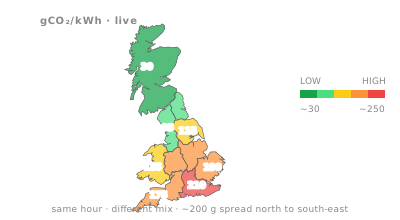
Same grid, different mix
Electricity is electricity — the electrons crossing your meter don't care where they came from. But the mix on the grid varies hugely by region, because each part of Britain sits closer to different generation:
- Scotland has most of the UK's onshore wind, the Beatrice and Seagreen offshore wind farms, the Cruachan pumped-hydro plant, and Torness nuclear. On a windy day Scotland generates roughly twice what it consumes and exports the rest south.
- The North East and Yorkshire have Drax (biomass), Hartlepool nuclear, and large offshore farms off the Humber. Carbon-light most of the year.
- South Wales and the Midlands lean heavily on the big CCGT (gas) stations — Pembroke, Connah's Quay, West Burton. Higher carbon when gas runs.
- The South East has the smallest share of zero-carbon generation per capita and depends most on imports from France and Belgium plus gas-fired stations. Highest carbon intensity in the country on most days.
The dashboard's map colours each region by its current grams-of-CO₂ per kWh. The contrast between northern Scotland and the South East often reaches 150–200 g — the same hour, two completely different grids.
What the regions actually are
There are several overlapping geographic divisions of Britain's electricity system. Distribution is split into 14 DNO licence areas operated by six companies — UK Power Networks (London + South East + Eastern), SSEN (north Scotland + Southern), SP Energy Networks (south Scotland + Merseyside & North Wales), Northern Powergrid (North East + Yorkshire), Electricity North West, and National Grid Electricity Distribution (Midlands + South West + South Wales). The Carbon Intensity API publishes intensity values per region using these areas, sometimes merged to a smaller statistical set; the dashboard's choropleth and this illustration use that simplified set.
A few terms worth knowing:
- DNO — Distribution Network Operator. Six companies across fourteen licence areas, regulated by Ofgem. They run the local poles, lines, and substations.
- GSP — Grid Supply Point. The transformer site where transmission (400/275 kV) hands off to distribution (132 kV and below). There are about 380 GSPs in GB; each maps to one DNO region.
- NESO regions — the system operator publishes operational data on a few different aggregations. The 14 DNO areas are the canonical set; this dashboard's map (and most consumer dashboards) collapse them into 11 polygons to keep the choropleth legible — Scotland is one shape, the two SP Energy Networks areas merge with North West, and so on.
How the map is generated
Every five minutes the dashboard pulls the Regional Carbon Intensity feed and the per-region generation mix. Each region's intensity is a weighted average of the fuels supplying that region, where the weighting accounts for both local generation and the transmission flow into the region.
So a London hour with low wind and high gas reads ~250 g/kWh. The same hour in the Highlands, with abundant wind exporting south, reads ~30 g/kWh. The contrast on the dashboard isn't a rendering glitch; it's real, and it's bigger than most people expect.
What this tells you
- Where the power is coming from. Cool greens follow the wind. Warm oranges follow the gas plants and the demand centres.
- Where it pays to time-shift. If you live in Scotland and have a flexible tariff (or a heat pump), the cleanest hours arrive earlier and last longer than they do in the South East.
- Why transmission upgrades matter. Most British wind capacity is in Scotland; most demand is in England. The 600-km Eastern HVDC Link (under construction) and the new northern Anglo-Scottish 400 kV reinforcements exist to move clean Scottish electrons south.
Common misconceptions
- "My region's carbon number is what I'm consuming." Closer to it than the national figure, but still an average; specific large industrial consumers can be on very different contracts.
- "Scotland has its own grid." Britain has a single synchronous grid that runs at 50 Hz from Cape Wrath to Land's End. The "regions" are accounting boundaries, not separate systems.
- "The colours come from emissions sensors." They come from modelling — the Carbon Intensity API multiplies each region's estimated generation mix by per-fuel emissions factors. The methodology is open.
Further reading
- Carbon Intensity API regional methodology — exactly how the per-region intensity is computed.
- Ofgem map of DNOs — which company runs the wires under your street.
- NESO Future Energy Scenarios — the system operator's 30-year outlook; chapter on transmission shows where the GW need to move.