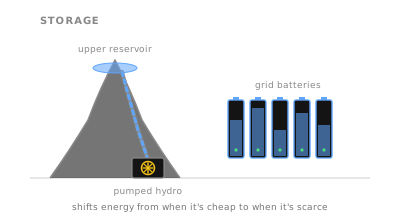
Why storage matters more than its share suggests
On a normal hour the Storage bucket in the generation donut is half a percent of demand or less. So why bother explaining it?
Because storage is the only generator on the system that can do all three of these things on demand:
- Discharge GW of clean energy for a few hours.
- Absorb GW of surplus generation instead of curtailing wind.
- Switch direction in seconds, faster than any thermal plant can ramp.
That makes storage a load-shifter and a balancing tool. Without it, NESO has to pay wind farms to switch off when demand is low — which they do, often, to the tune of more than £1 bn a year. With it, the same MWh gets stored at midnight and sold back at 6 pm.
Pumped hydro — the legacy backbone
Britain has four pumped-storage stations, all built between 1963 and 1984:
| Station | Location | Power | Energy stored | Built |
|---|---|---|---|---|
| Dinorwig | North Wales | 1.7 GW | ~9 GWh | 1984 |
| Cruachan | Argyll | 0.4 GW | ~7 GWh | 1965 (expansion in progress) |
| Foyers | Loch Ness | 0.3 GW | ~6 GWh | 1975 |
| Ffestiniog | North Wales | 0.4 GW | ~1.4 GWh | 1963 |
Total: 2.8 GW of pumped capacity — enough to power about 9% of UK peak demand for a few hours. When the Generation card shows "Pumped Storage 0.3 GW", it means one or more of these is running its turbines and shifting water from the upper reservoir to the lower.
When demand is low (overnight, or windy weekend afternoons), the same stations run their pumps in reverse, drawing power from the grid to refill the upper reservoir. On the dashboard that shows up as a negative flow — generation goes "into" the bucket — or simply absence from the donut if the value is below the display threshold.
Two new pumped-hydro projects are in development for the late 2020s: Coire Glas (1.5 GW in the Scottish Highlands) and an expansion at Cruachan. Together they'd more than double Britain's pumped capacity.
Grid-scale batteries — the new wave
Battery storage was negligible in 2018. By 2025 it had grown to over 5 GW of installed capacity with another 10+ GW in advanced construction. Most projects are co-located with wind or solar farms, or sited at substations to provide frequency-response services to NESO.
A few characteristics worth knowing:
- Power vs energy. A "50 MW / 100 MWh" battery means it can deliver 50 MW for two hours. Most current deployments are 1- to 2-hour batteries; 4-hour systems are starting to appear.
- Round-trip efficiency is about 85% for lithium iron phosphate (the dominant chemistry). Pumped hydro is ~75%. So batteries are slightly less wasteful per MWh stored.
- Response speed. Batteries can swing from full charge to full discharge in milliseconds, which makes them indispensable for frequency response — keeping the grid at exactly 50.0 Hz against constant small fluctuations.
On the dashboard, when batteries are discharging (sending power to the grid), the Battery slice in the Storage bucket lights up. When they're charging, they're effectively load — they don't show as generation, and the demand-side number ticks up by the charge rate.
How storage shows up on the dashboard
The Storage bucket aggregates pumped storage and battery output:
- Discharging: appears in the donut at the storage colour, with a positive MW number.
- Charging: not shown in the donut. The energy is going into storage, so it's counted as part of demand.
- Idle: 0 MW. Most stations sit idle outside the 17:00–20:00 peak and the overnight pumping window.
The Generation Mix breakdown shows pumped storage and battery as separate fuel rows inside the Storage bucket so you can see which is doing the work.
Why storage is growing so fast
Three converging forces:
- Renewables need it. When the windiest hour produces more than demand, the only options are export, curtail, or store. Storage avoids the £200/MWh constraint payments that wind farms otherwise earn for sitting idle.
- Lithium prices keep falling. The installed cost of a grid-scale lithium battery dropped roughly 80% between 2015 and 2024. Deployment economics are now favourable without subsidy in most markets.
- Frequency response pays. NESO's Dynamic Containment and Dynamic Moderation services pay batteries for keeping a reserve ready to respond to grid frequency excursions. Storage's revenue stack is currently 50–70% from frequency services rather than energy arbitrage.
By 2030, official NESO scenarios have 20–30 GW of battery storage on the system, with pumped capacity around 4 GW. Storage will still be a small share of total energy delivered, but a critical share of when and how it's delivered.
Common misconceptions
- "Storage is a power source." It's energy-shifted. The MWh that comes out had to be generated by something else first; storage just moves the timestamp.
- "Batteries are too small to matter." A single 100 MW battery delivering for 2 hours can replace a 100 MW gas peaker that ran for the same window — and the battery's emissions are zero.
- "Pumped storage is old technology." The stations are old; the role is brand new. The 60-year-old Dinorwig is one of the most economically active power stations on the system in 2026.
Further reading
- NESO Storage Pathway — the system operator's outlook on storage growth and roles.
- Modo Energy — daily battery-storage market analytics, public dashboards on revenue stacks.
- Wikipedia: Dinorwig Power Station — background on the largest pumped-storage station in Europe.