"Demand" isn't one number
British grid data ships with at least four different definitions of "demand", and most public dashboards pick a different one. Compare any two of them at the same moment and you'll often see headline figures that differ by 2 to 4 GW. That's not a bug — it's the cost of using overlapping but distinct measurements.
The four you'll meet most often:
| Acronym | What it measures | Roughly | Source |
|---|---|---|---|
| ND (National Demand) | Power crossing the transmission system to GB consumers, minus embedded supply | 22–32 GW | NESO |
| TSD (Transmission System Demand) | ND plus station load, pumped-storage pumping, and interconnector exports | 24–35 GW | NESO |
| INDO (Initial National Demand Outturn) | NESO's earliest near-real-time ND estimate | publishes ~10 min after the period | NESO |
| Total consumption | Everything actually used in GB, including embedded supply meeting local demand | 28–42 GW | derived |
This dashboard's headline DEMAND is total consumption — the supply side summed up (transmission + embedded + net imports). It tends to read a couple of GW higher than ND on sunny afternoons because all that rooftop solar is meeting demand without ever showing up at transmission level.
Why ND drops below total consumption
Imagine a sunny midday. Rooftop solar across Britain is generating 8 GW into people's homes, offices, and warehouses. That generation never leaves the local distribution network, so the transmission system only has to deliver the remainder of national demand.
- Total consumption: 30 GW
- Embedded supply (mostly rooftop solar + small wind farms): 8 GW
- ND (what transmission has to deliver): 22 GW
ND is the number NESO uses for forecasting how much power to dispatch from gas, nuclear, and the big wind farms. Total consumption is the number that better reflects what households and businesses are using. Both are correct — they just answer different questions.
See Embedded wind and solar for more on the 8 GW that gets subtracted.
The shape of a British day
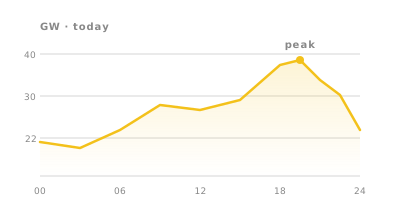
Demand is rhythmic. A normal weekday in mid-2026:
- Overnight trough (02:00–05:00): ~22 GW. Industrial baseload, freezers, street lights, a few EVs charging.
- Morning ramp (06:00–09:00): climbs to ~28 GW as households and offices wake up.
- Daytime plateau (10:00–16:00): ~26–30 GW, with embedded solar quietly suppressing the visible ND.
- Evening peak (17:00–19:00): the sharpest moment of the day, often 36–42 GW. Cooking, heating, lights, return-home commute.
- Late evening tail-off (20:00–23:00): back down through 28 GW toward the trough.
Weekends shave 3–5 GW off the peak. Bank holidays shave more. Winter is broadly higher than summer; February evenings can pull 5 GW above their July equivalents.
What moves it long-term
- Efficiency. UK electricity demand peaked in 2005 at over 60 GW and has trended downwards as LED lighting, better insulation, and offshoring of heavy industry knocked tens of GW off the total.
- Electrification. EVs, heat pumps, and electric cooking are pushing it back up. Forecasts have demand returning to ~50 GW peak by the late 2030s.
- Behind-the-meter solar. Embedded solar growth is hollowing out the daytime ND number — there are now sunny weekend days where transmission demand drops below 18 GW at noon.
How to read it on the dashboard
The Demand card shows:
- Big number: total consumption (the supply-side sum).
- Generation leg: domestic generation (BM + embedded), in GW.
- Transfers leg: net interconnector flow. If positive, GB is importing.
- The two legs add up to the headline.
When NESO publishes its settled ND for the half-hour (usually within the hour), the dashboard switches to that figure for historical periods, because ND is what NESO has actually measured rather than what we've derived.
Common misconceptions
- "Demand is what's being generated." Demand is what's being consumed. In a perfectly balanced grid the two equal each other minute by minute, but generation and demand are conceptually distinct.
- "Demand dropped because the economy is shrinking." Demand has dropped because we use electricity more efficiently — fridges, lights, motors, factories. Output per kWh has roughly doubled since 1990.
- "If one dashboard shows 32 GW and another shows 30 GW, one must be wrong." Both can be right. Different aggregations of the same underlying readings, sampled at slightly different moments.
Further reading
- NESO Data Portal — demand data — every settled half-hour back to 2009, plus ITSDO and ND definitions.
- Drax Electric Insights — demand — interactive demand charts with embedded breakdown.
- DESNZ Energy Trends, Section 5 (Electricity) — official quarterly demand statistics in TWh.