What it is
Carbon intensity is the average amount of CO₂ released per unit of electricity generated. The number on the dashboard, usually 30 to 350 gCO₂/kWh, tells you how clean a kilowatt-hour of British electricity is right now.
It's a weighted average. At any half-hour the grid is running a mix: wind, solar, nuclear, gas, biomass, hydro, imports. Each fuel has its own emissions factor (zero for wind, solar, and nuclear; around 390 gCO₂/kWh for combined-cycle gas; about 940 for coal). Multiply each fuel's share by its factor, sum, and you get the live intensity for the whole grid.
How it's computed
Three inputs feed the calculation, published by the Carbon Intensity API, a service run by National Grid ESO, the Environmental Defense Fund, the University of Oxford and WWF:
- The current fuel mix. Half-hourly settlement data from Elexon's FUELINST feed, plus NESO's embedded wind and solar (the rooftop generation Elexon doesn't see; see Embedded wind and solar).
- Per-fuel emissions factors. Per-fuel gCO₂/kWh values curated by the partner consortium, updated as the methodology evolves.
- A weighting. Each fuel's share of total generation × its factor, summed, rounded to the nearest whole gCO₂/kWh.
The API publishes a forecast ahead of time using NESO's day-ahead schedule, and an actual that lands roughly 30 to 60 minutes after the period closes. Both numbers reach this dashboard.
How to read it on the dashboard
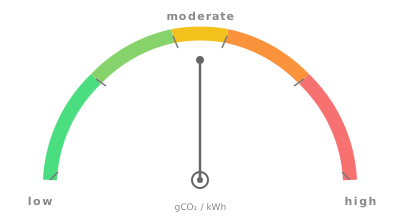
The Carbon card shows the live value and a coloured chip: very low, low, moderate, high, very high. These are the API's own thresholds, and they shift down each year as the grid decarbonises. In 2018 "high" started around 285 gCO₂/kWh; by 2026 the same label kicks in at ~180. The gauge below the value plots where you sit in the current bands.
The chip label is derived from the displayed value using the dashboard's own band cutoffs, so the chip and the gauge never disagree.
Common misconceptions
- It's a national average, not a measure of any specific power station. A particular gas turbine's emissions don't change minute to minute; the grid mix does, and that's what moves the number.
- Forecast and actual differ by 10 to 30 g most days. The forecast is based on planned generation; the actual is the real mix after the period closes. Both are useful.
- Lower isn't always cheaper. Nuclear and wind are both close to zero gCO₂/kWh, but the wholesale price moves with the marginal fuel (usually gas). See The wholesale market index price.
- Embedded solar counts. Rooftop solar isn't connected to the high-voltage network, but it reduces what the rest of the grid has to generate, and the API factors that into the per-fuel weighting.
Why it matters
Demand-shifting (running the dishwasher at noon on a sunny day instead of 7pm on a calm evening) can cut the carbon attached to that load by 5× or more. The dashboard's carbon scale tells you when the grid is at its cleanest. Time-of-use tariffs (Octopus Agile, Intelligent Octopus, others) price electricity using a similar signal: cheaper power tends to be cleaner power.
Further reading
- Carbon Intensity API methodology — the canonical reference for emissions factors and band thresholds.
- Drax Electric Insights — live and historical dashboards run by Imperial College, with breakdowns by fuel and source-attributed carbon.
- NESO data portal — historical generation data back to 2009 if you want to build your own calculation.